Child and Teen Safety

Listed below are various ways that children, teens and adults can work together to ensure child and teen safety.

During the warmer seasons, many young people ride their bikes to school. To ensure our roads are safe for everyone who uses them, including bikes, cars and pedestrians we have a number of safety tips that can help you navigate through traffic safely:

Safe Biking Tips

  • Bike on right hand side of the road with the flow of traffic. If you feel unsafe on the road, get off and walk your bike on the sidewalks.
  • Wear a bicycle helmet that fits to reduce the risk of injury.
  • Keep your bicycle in good working condition by using the ABC checklist.
  • Be alert and pay attention to your surroundings.
  • Watch out for pedestrians.
  • Ride in a single file.

Children's Sidewalk Bicycling

In the Region of Peel, only bicycles with wheels less than 50cm (20in) in diameter, the size of most children's bike wheels are allowed to cycle on the sidewalks.

When Crossing Intersections

  • Stop before entering into the roadway.
  • Push the pedestrian button (when available).
  • Wait for the pedestrian walk sign.
  • Stop, look all ways and listen for traffic.
  • Make eye contact with stopped drivers. 
  • Look for turning vehicles before crossing and cross safely when the road is clear by walking, not running.
  • If riding your bicycle on the road, ride through the intersection when it is your turn and safe to do so.
  • If riding your bicycle on the side walk, stop at the end of the sidewalk, get off your bike and walk it across when road is clear.

Remember, be seen, be heard, and be safe.

ABC Checklist – Keeping Your Bike Ride Smooth

Air:

  • Tires have enough air.
  • Wheels spin freely.

Brakes and bars:

  • Brakes work.
  • Handlebars are stable.

Chains and crank:

  • Chain is tight and lubricated.
  • Pedals spin freely.
  • Crank is not wobbly.

To learn how you can increase your confidence and improve your riding skills through a cycling course or community ride, visit Walk and Roll Peel.

For more cycling safety tips, check out Road Safety.

Protecting Your Bike - Bike Registry

Peel Regional Police offers online bicycle registration. By registering your bicycle, your chances of having your bicycle returned if it's lost or stolen, greatly increases.

For more information or to register your bike, visit Bike Registry.

Bullying is when someone repeatedly does or says something to hurt someone else on purpose.

Common Types of Bullying

  • Cyber-bullying – Performed through electronic devices (usually on social media sites) to threaten, harass, embarrass, socially exclude, or damage reputations and friendships.
  • Disability bullying – Includes leaving someone out or treating them badly because of a disability, making someone feel uncomfortable, or making jokes to hurt someone because of a disability.
  • Physical bullying – Includes hitting, kicking, shoving, spitting, beating up, stealing or damaging property.
  • Racial bullying – Treating people poorly because of their racial or ethnic background; includes saying bad things about a cultural background, calling someone racist names or telling racist jokes.
  • Religious bullying – Treating people badly because of their religious background or beliefs; includes making negative comments about a religious background or belief, calling someone names or telling jokes based on his or her religious beliefs to try to hurt them.
  • Sexual bullying – Includes leaving someone out; treating them badly, or making them feel uncomfortable because of their gender; making sexist comments or jokes; touching, pinching or grabbing someone in a sexual way; making rude comments about someone's sexual behaviour or orientation; or spreading a sexual rumour.
  • Social bullying – Includes excluding others from the group, getting others to ignore or exclude people, gossiping or spreading rumours, setting others up to look foolish and damaging reputations and friendships.
  • Verbal bullying – Includes name-calling, mocking, hurtful teasing, insults, slurs, humiliating or threatening someone, racist comments, or sexual harassment.

For more information, visit PREVnet.

Warning Signs

  • Avoids using their devices, or deletes their social media accounts.
  • Is often upset after receiving online/text messages.
  • Lower interest in activities and lowered performance at school.
  • Fear of going to school.
  • Isolating themselves from friends and family.
  • Complains of not feeling well (e.g. headaches, stomach aches etc.).
  • Lower self-esteem.
  • Loses things.

If I am Being Bullied

  • Hang out with friends that support you.
  • Talk to someone that you trust.
  • Document inappropriate messages received as evidence; keep it stored away if needed for future police action. Track the dates, times, and descriptions of the incidents.

If I See Bullying Happening

  • Stand up, but only if you feel safe to do so.
  • Find a positive, safe way to intervene, to try to stop the bullying behaviour.
  • Try to talk to and support the person who is being bullied.
  • Find an adult you trust to assist you.
  • Consider bringing the person being bullied into a safer environment with supportive people.

If Someone I Know is Being Bullied

  • Listen and be supportive.
  • Report incidents of bullying to the school administration.
  • Encourage them to standing up for themselves and talk to a trusted adult.
  • If threats, harassment, theft, assault, mischief or exploitation are involved report it to police.

I am a Bully, Now What?

  • Consider apologizing in person to those you've hurt.
  • Take responsibility for your actions.
  • Speak to a trusted adult about how you feel and seek advice.
  • Find positive, supportive friends that help you make good choices.

How to Help a Bully Change

If you are concerned that your child, friend, student or family member is a bully, you should provide:

When do I Call Police?

When threats, harassment, assault, theft, mischief are involved the bullying should be reported to the police. In an emergency, contact 9-1-1, otherwise call our non-emergency line.

Bullying Resources

Street-proofing techniques can be used by your children in numerous situations. Teaching children the proper skills can assist in protecting them in dangerous situations.

Street-Proofing Tips

Teach your child to:

  • Get help from those considered as safe people (Police officers, firefighters and paramedics).
  • Run and find a safe person if a stranger/bad person offers candy, money or for help.
  • Never approach a car driven by anybody who is attempting to get their attention (Adults shouldn't be asking kids for help).
  • Yell STRANGER, STRANGER over and over again and do what ever it takes to break free and run away.
  • Always be aware of your surroundings.

Tips to Keep your Child Safer

  • Keep an up-to-date photograph and other detailed information about your child on a file at home. This information will assist police if a child goes missing or gets lost.
  • If your child becomes separated, don't panic, instead go to the nearest security or courtesy desk (if you are at home call 9-1-1).
  • Know who your children play with, including where they go and what routes they take.
  • Don't leave your child in unsupervised locations (cars, parks, malls etc.).

If Using a Babysitter or Daycare Service

  • Check the credentials thoroughly and talk with parents who are currently using this service or have used it in the past.
  • Make sure the sitter has the necessary experience in childcare. This may include CPR and first aid training.
  • Always leave the address and telephone number of where you are going with the babysitter. If you change your plans, call and advise the sitter of the new information.

Tips When Walking Home Alone

  • Inquire about your school's safety policy.
  • Make sure children know their parent/guardian contact information and know how to contact a trusted adult if they feel unsafe.
  • Take time to get familiar with the best route to and from school and walk the route with them.
  • Avoid having their name visible on their clothing, lunch boxes and other belongings, as it advertises to everyone who they are.

Walking With Electronic Devices

Electronic devices, such as smart phones and IPods, can be distracting to people, making them unaware of their surroundings. Only provide responsible and age appropriate children with these devices. Consider limiting the use of electronic devices and earphones when in isolated areas or while crossing roadways and railway tracks.

Types of Drugs

A drug is anything ingested or absorbed, other than food, which affects the way a person's body or mind functions. There are three main categories of drugs: stimulants, depressants and hallucinogens.

  • Stimulants - Drugs that speed up functions, such as breathing, movements and heart rate, e.g. Caffeine, Cocaine, Ecstasy, Marijuana.
  • Depressants - Drugs that slow down functions, such as breathing, movements and heart rate, e.g. Alcohol, Marijuana, Prescription pills.
  • Hallucinogens - Drugs that work on the brain to affect the senses, this drug distorts awareness and perception, e.g. LSD, Ecstasy, Marijuana, Salvia.

Signs of Drug Use

  • Suspicious objects/paraphernalia.
  • More secretive and less co-operative.
  • Changes in behaviour/personality.
  • Depression.
  • Bloodshot eyes.
  • Trouble thinking clearly.
  • Difficulty maintaining relationships.

Note: possible signs mentioned above are indicators to watch for, but does not confirm the person is involved in drugs.

Helpful Resources

Human trafficking is occurring in our own communities. It refers to the recruitment, transportation or harboring of persons for the purpose of using them in the sex industry/prostitution (also known as The Game) or for forced labour.

Youth are extremely vulnerable to becoming a victim, averaging 13-21 in age.

Tips to Be Safer Online

  • Never agree to meet someone they've met online.
  • Avoid using a Web Cam or digital camera without close supervision.
  • Use privacy controls to restrict unwanted people's access to your pages.
  • Avoid giving out personal information (i.e. name, address, school you attend).

To Ensure Your Child is Safer Online

  • Have open lines of communication with them and establish ground rules on their internet usage.
  • Become more computer and internet savvy by learning what your children do online.
  • If your child or teen is using a social media platform, you should be too. Make this a joint online learning experience for both you and your child.
  • Check out parental controls available on your online service and block inappropriate websites.
  • Keep the computer in a public area in your house (avoid having a computer in their room).
  • Learn how to set up privacy controls.

To Learn More About Cyber-Safety

Our Cyber Academy offers cyber related course for parents, caregivers, educators and other professionals. Learn more by emailing cyberproofed@peelpolice.ca.

What is Operation Freeze/Heat?

Operation Freeze and Operation Heat is a partnership between Peel Regional Police and Circle K Convenience Stores that encourages youth to learn that doing the right thing is cool.

What is Positive Ticketing?

Positive ticketing encourages positive interactions between youth and officers. Some police officers may use the coupons to recognize youth for wearing bicycle helmets, doing good deeds and following school crossing rules. Other officers may use them as icebreakers to start conversation with youth in their patrol areas. The coupons are for a free beverage at all participating Circle K Convenience stores across Ontario. In the Peel Region, our officers have issued over 65,000 positive tickets.

Education Programs

The Youth Education Bureau's mission is to work with community partners in order to empower every child and youth with the capacity and inspiration to promote safety while preventing violence, crime and victimization. Youth Education Officers work with numerous partners in order to create a positive and safe learning environment within the elementary school system through presentations and programs.
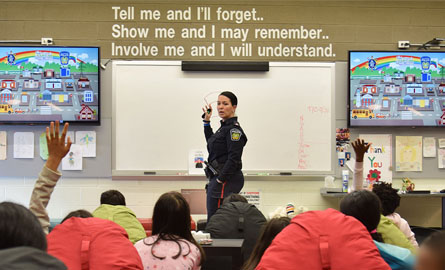
Group of kids sitting on bean bag chairs with teacher

Program Descriptions

Book your Class

Youth Education - Grades 4-8, Ages 9-13

Personal Safety - Grade 4
Emphasis is placed on the importance of a home safety plan and avoiding harm while out in the community. Students will be re-acquainted with the basic principles of navigating their day-to-day interactions while emphasizing the importance of staying safe, both within their community and at home.
Intro to Social Media - Grade 6
This session is an extension of the grade 4 Internet Safety program. It is intended to guide students in the risks associated with various social media platforms.
Digital Leadership/Social Media - Grade 7 and 8
The Digital Leadership program reviews and builds upon learning from previous years. The session emphasizes individual responsibility while using the internet and social media, and discusses age appropriate topics that affect youth health and safety.
IVY (Intervention for Vulnerable Youth) - Grade 8
To contribute to a safer community together, this program is designed to raise awareness and prevention about youth and their risks to human trafficking. Specifically, what signs to look for that may indicate a student is being targeted and how to prevent being a target.

Crime Prevention (available for High Schools +) - Grades 9-12, Ages 14-18

Social Media

Learn about the positives and negatives of social media. This program, administered by a police officer, delivers a unique and fulsome perspective of current crime trends while promoting community safety and well-being.

Drug Education

Learn about drug awareness and the law. This program, administered by a police officer, delivers a unique and fulsome perspective of current crime trends while promoting community safety and well-being.

Cyberbullying

Learn about signs and prevention. This program, administered by a police officer, delivers a unique and fulsome perspective of current crime trends while promoting community safety and well-being.

Media Addiction

Learn about issues caused by constant media use. This program, administered by a police officer, delivers a unique and fulsome perspective of current crime trends while promoting community safety and well-being.

Frauds & Scams

Learn about preventing being a victim. This program, administered by a police officer, delivers a unique and fulsome perspective of current crime trends while promoting community safety and well-being.

Personal Safety

Learn about protecting yourself within the community. This program, administered by a police officer, delivers a unique and fulsome perspective of current crime trends while promoting community safety and well-being.

Media Distraction

Learn about driving while distracted. This program, administered by a police officer, delivers a unique and fulsome perspective of current crime trends while promoting community safety and well-being.

Domestic Human Trafficking

Learn about possible signs/risks of Human Trafficking. This program, administered by a police officer, delivers a unique and fulsome perspective of current crime trends while promoting community safety and well-being.

 Safety Village - Grades 1-5

Grade 1 – Community Helpers & 9-1-1
Community Helpers

Introduces students to Safe People within our community: Police, Firefighters and Paramedics
Learn how to identify them and learn about their tools, vehicles, and uniform

30-45 min.

9-1-1

Learning what a 9-1-1 emergency is
What will happen when they call 9-1-1
Importance of knowing your personal information (address, telephone number)

30-45 min.

Grade 2 – Personal Safety and Pedestrian Safety
Personal Safety

Define GOOD, BAD and SAFE people
Tricks ‘Bad’ people use
Importance of yelling ‘STRANGER’

30-45 min.

Pedestrian Safety

What is a safe Pedestrian?
Stop Look ALL ways & Listen
Traffic Lights
Crosswalks

30-45 min.

Grade 3 – Personal Safety and Bicycle Safety
Personal Safety

Review GOOD, BAD and SAFE people
Teach Personal Safety Rules:
Check First, Take a friend, Say ‘No’, and talk to a trusted adult

30-45 min. 

Bicycle Safety

Rules of the Road
Importance of a Helmet
How to fit a Helmet (2 v 1)

30-45 min.

Grade 5  - Internet Safety
  • Protecting Personal Information
  • Social Media Safety
  • A picture is worth a thousand words
  • Security Settings
  • Online Dangers
  • Cyberbullying & Cyber Citizenship
  • Online Predators & Lures

2 hours (includes break)

Visit Peel Children's Safety Village for more information.

Book your Class


Presentations offered within the Crossroads Youth Academy, in partnership with Peel Regional Police.